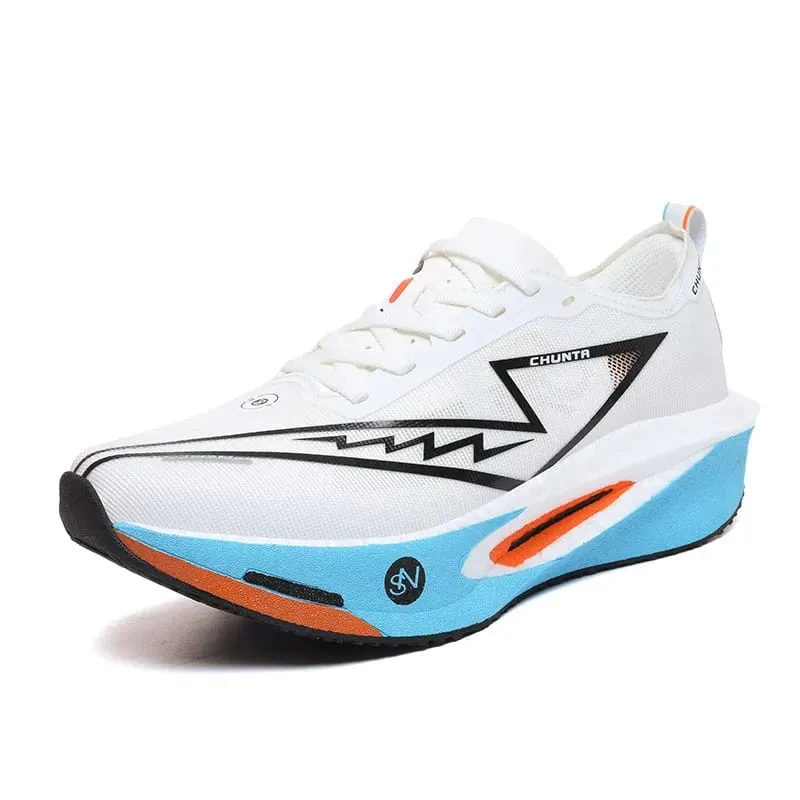
A quick note before we get into it: I've had these sitting on the shelf for a few weeks now, and I keep pulling a pair out to show people. Not because they're the fanciest thing we stock — they're not — but because they're the pair that makes people go "wait, really?" when I tell them the price. So let me tell you about them the way I'd tell a friend who walked into the shop.
First, what you're actually getting. The upper is a woven mesh — breathable, open enough that you can feel air moving through it when you hold it up to a fan, but tightly woven enough that it hasn't snagged or frayed on the pairs I've handled. The tongue and collar are padded without being bulky, and there's a reinforced heel counter back there that gives the shoe some real structure instead of flopping over like a sock when you set it down. The headline feature is the carbon board embedded in the midsole, sandwiched between layers of lightweight foam. I'll be straight with you: at this price, it's not the same carbon plate you'd find in a two-hundred-dollar race shoe. It's thinner and more flexible, but it's there, and you can feel it — that slight stiffness under the ball of your foot that pushes you forward a little on toe-off. The outsole is a rubber compound with a decent tread pattern, and the stitching throughout is clean. No loose threads, no glue smears at the seams. For the money, the build quality genuinely surprised me.
Now the specs, because I know some of you skip straight to this part. The SKU is P3256812655574727, so if you're looking it up or asking us about it, that's the number to have. Sizes run 36 through 41 — yes, it's listed in the men's category, but the sizing runs small, so a lot of women are buying these and a lot of men are sizing up. If you normally wear a 42, you'll want the 41 here, and even then it may fit snug. Colors are straightforward and clean — nothing loud, which I actually like. And the listed product name says "Women's Comfortable Athletic Sneakers" while sitting in the men's section, which tells you what you probably already guessed: this is a unisex shoe. The "marathon" in the name is marketing. It's a training shoe, not a race-day shoe, and I'd rather you know that going in.
As for what people actually do with them — I've watched how these get used, and it's rarely what the name suggests. One customer bought a pair for his daily three-mile jog on pavement, and he told me the cushioning held up fine after two months, though he rotates them with another pair. Another uses hers for long shifts on her feet — hospital floors, twelve hours — and said her knees felt better than with the cheap flats she'd been wearing. And a third guy, honestly, bought them because they look slim with jeans and he wanted something light for walking the dog and running errands. That's the real story of this shoe: it's a good everyday athletic sneaker that happens to have a carbon board in it.
Using and maintaining them is simple, but a few things matter. Break them in gradually — the carbon board doesn't flex the way a soft foam shoe does, and if you go straight into a ten-mile run on day one, your calves will let you know. Start with short walks or easy jogs for the first week. Lace them snug through the midfoot; the mesh has some give, so a loose lacing lets your foot slide. For cleaning, pull the insoles out, use a soft brush with lukewarm water and a little mild soap, and air-dry them at room temperature. Do not put them in the dryer and do not leave them on a radiator. Heat is what kills the foam and can warp the board. If they get soaked, stuff them with newspaper and let them sit overnight.
The pros, honestly: they're light, they breathe well, the carbon board gives a nice rolling feel on longer walks or jogs, and they look clean enough to wear with anything. The cons, just as honestly: the sizing is a real issue — if you have wide feet or wear above a 41, these aren't for you. The cushioning is on the firm side, so if you want a plush cloud-like ride, look elsewhere. Durability on the outsole is average; heavy daily runners will wear through the heel rubber in a few months. And I'd treat the "marathon" label as decoration, not a promise.
Here's the technical read on why this design works. A carbon board in the midsole does two things: it stiffens the shoe so your foot doesn't have to work as hard through the push-off phase, and it creates a lever effect that rolls you forward. On a lightweight mesh upper, that combo keeps the total weight down while adding propulsion — that's the whole trick. But softer foam plus a rigid board equals less natural flex, which is why this shoe suits a specific person: the casual runner doing three to six miles a few times a week, the walker covering serious ground, the person on their feet all day who wants a bit of bounce without bulk. It does not suit heavy runners, wide feet, or anyone chasing a personal record. And it absolutely suits someone who wants a taste of that carbon-plate feel at twenty-seven dollars and change, which is exactly the kind of customer I see buying it.